Often in the ugly world of racial prejudice, people judge and discriminate against an entire ethnic group when a small part of it is deemed to have done something bad. But hypocritically enough, those same people ignore the fact that several others of their own ethnicity have also committed awful crimes. This vile mindset, nonetheless, grows and leads to groups of people to, as a whole, resent each other even further. Irony comes to view where hatred evolves into a strong factor of bringing and connecting humans together. It is an endless cycle that spreads continuously, and while there are many acts attempting to eliminate this thing called racism, the grimmer side of society cannot help but repeat.
An infamous example of racism is the negative results brought from the Pearl Harbor attack, which revealed the dark side of humans as they would team up against an innocent group of people, distinguishing them from the rest. The treatment of Japanese-Americans, who are full citizens of the United States, became a national problem—from being judged by their own neighbors to eventually being restricted from their own rights. Families were taken away from their once comfortable, bright homes to a confined camp that felt like prison, hovered by tall fences that isolated them from the outside world. They were left to unfairly follow orders by the very people that showed them prejudice, and questioning about it meant an act of rebellion and betrayal.

(time.com)
The graphic novel They Called Us Enemy illustrates the life of George Takei, who was one of the children taken to a camp with his parents and siblings. As a family of five, they were cramped in a horse stall to sleep in, suffered with unsanitary conditions and lack of resources, restlessly moved to another camp when they were ordered to, and seldom had a say in anything. Day by day, George’s innocence slowly diminished, and he came to realize that the situation he was in was plainly unjust. As a result, he no longer had a childhood to enjoy because “how can one think of ‘play’ when there is so much cruelty,” as stated in the Play Mountain podcast by 99 Percent Invisible that talked about how Isamu Noguchi, a Japanese-American artist, had also endured the hardships from the Pearl Harbor attack. Although the damages were ultimately repented and the isolation ceased, it was still an unforgettable experience that haunted many people’s lives; in the end, they lost their jobs and homes, and starting over was much more difficult than said.
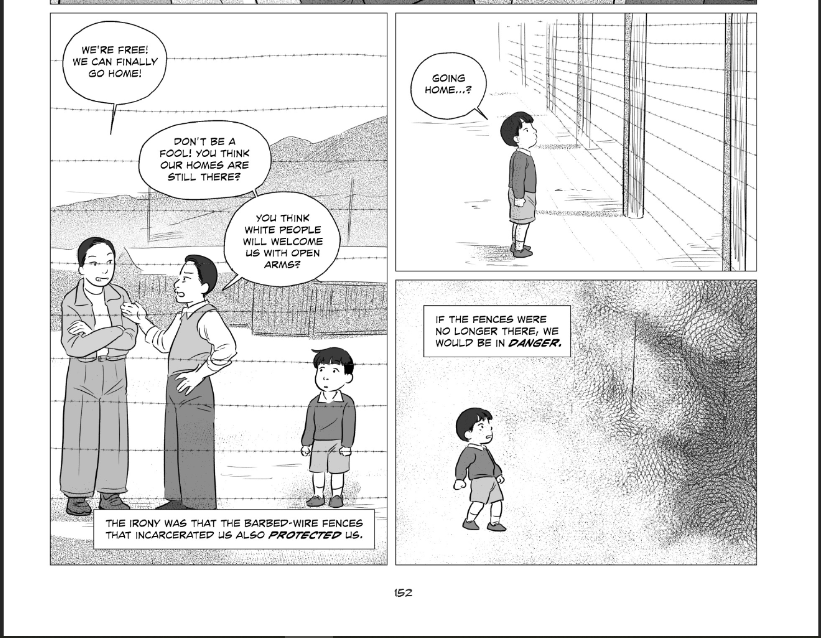
(They Called Us Enemy)
Greatly portraying the saying that “violence begets violence,” recurrent events and incidents tying to racism never really stopped as they only gave rise to another. The hatred between two groups is never one-sided, for the one receiving terrible treatment would, in the course of time, return the resentment; hence, the purpose for protests. People join together to fight for their rights and justice, and yet it creates a gap that separates different groups and communities. Subsequently, people tend to have a reason not to trust one another rather than a reason to trust. According to Helen Zia, an activist against Asian-hate, “this [racism] was something that has been happening for a very long time and is actually part of the fabric of America, how Asian Americans have lived with this, ever since we have been in America. So, this is not something new” (pbs.org). Racial prejudice originates from way back, and as the mindset passes on from one to another, it goes on emerging and evolving each day. This suggests that unless people truly start to understand each other and cease the increasing ignorance, not only would these acts of racism continue to occur, but would also broaden the hatred of people within a single nation.
The grudge that a person holds for an ethnic group spreads to more people like a wildfire—it creates destruction that severely hurts others, and is then resolved one way or another. But facing reality, has the issue ever really stopped or does the scar never fades away? The latter seems to make more sense as people continue to, covertly or overtly, judge and discriminate against others based on their ethnicity, ignorantly using unsubstantiated fear and reason as an excuse to hate and damage other people’s lives. The resentment becomes mutual, and it grows into something bigger that leads to an inevitable clash between groups. It is a non-stopping cycle that would seem to slowly die down, until it repeats again. It is a mindless process that carries on from ignorance to ignorance, and the only way to fight against it is to educate young minds of its injustice, preventing them from being misled by the influence of the ugly side of the world.
 Write Our World