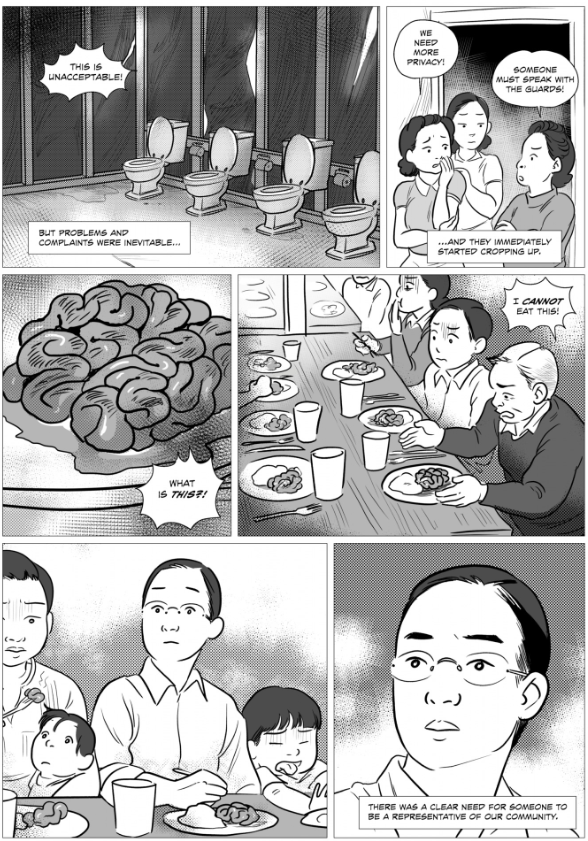
While reading They Called Us Enemy, I repeatedly noticed the subtle passive aggressive comments made towards the Takei family along with the other Japanese-American citizens. Sometimes these messages were plain aggressive. In the end, they always came from a place of fear, hysteria, and misinformation caused by the chaos of Pearl Harbor. However, the fault of the tragedy in Pearl Harbor did not fall upon Japan alone, but the Japanese citizens in America as well.
As I read further, I continued to question if these mistreatments still follow Asian citizens in America today. It is difficult to imagine that the unethical evacuation and then forcefully relocation to internment camps of Japanese-Americans can just simply be reversed or forgotten about. As an Asian-American and daughter of immigrant parents, I can say that the harmful stereotypes of Asians still follows us into the present day. I am grateful to live in a community with so much diversity, but racial stereotypes are apparent in the comments some people make. These may include “Where are you really from?”, “You’re Asian. Of course, you’re smart”, or “You’re so whitewashed”. Some comments may even come from another person of color, which proves how racial profiling may not always be conscious.
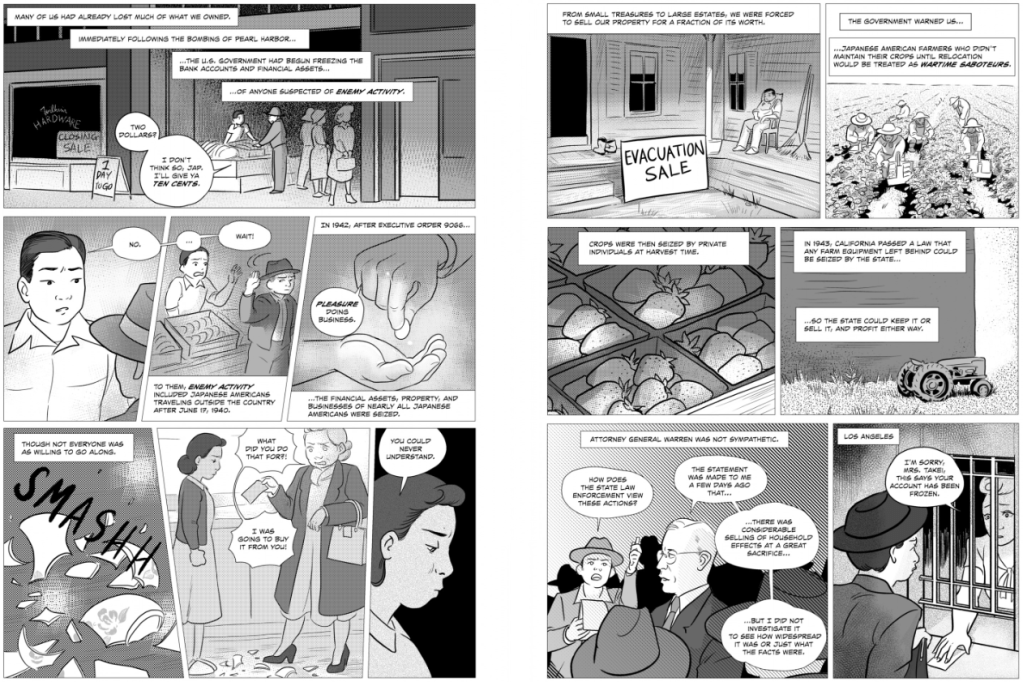
While diving deeper into microaggressions Asians face in their daily lives, I found a useful source from the University of Minnesota about the messages people convey when they say or do something racially passive aggressive. The source is called Examples of Microaggressions. Although there are many different types of microaggressions, this list is tailored towards racial microaggressions that minorities face in America. This is made apparent from the example, “As a woman, I know what you go through as a racial minority”. It’s true that women face discrimination, but racial discrimination is something that comes from cultural prejudice that seems to be passed down through generations. It is also much more generalizing by assuming everyone with the same race acts a certain way, so it cannot simply be compared to discrimination through gender.
When I read through the list, I continuously found myself familiar to the examples given. For example, a person asking an Asian American to teach them words in their native language, “Where were you born?”, or asking an Asian person to help with a Math or Science problem. I never knew that some of these examples had a negative connotation to them before researching further about it.
As I was trying to discover news songs about the Asian-American struggle, I realized that one of my favorite songs is actually about minority discrimination in America through their westernized beauty standards. In Your Best American Girl by Mitski, she describes her experience with the unfair American beauty standards that tailor towards western culture (tall, thin nose, large eyes, blonde hair, etc.) as a half-Japanese and half- Caucasian woman. She sings about how she will never be accept by her partner’s parents solely because of the way she was raised.
The most powerful lyric is:
“You’re the sun, you’ve never seen the night
– Mitski “Your Best American Girl“
But you hear its song from the morning birds
Well, I’m not the moon, I’m not even a star”
I interpreted this lyric as how white women (the sun) can never imagine what women of color’s struggles are like (the night), but they hear about it through media and news outlets (the morning birds). Mitski continues by describing herself as “not the moon, not even a star”. This might be her struggling with her racial identity as being half-Japanese and half-Caucasian, so she feels as though she doesn’t fit in any beauty standard.
I created drawings to represent the skills Asian- Americans used to get through the trying times after the bombing of Pearl Harbor. These skills are persisting, thinking and communicating with clarity and precision, and applying past knowledge to new situations.

The first image representing persisting is a reference to the Myth of Sisyphus. This legend is about how Sisyphus has to repeatedly push a boulder up a mountain. I chose this because I believed it accurately represented how minorities repeatedly face oppression, yet they still push through and work towards creating a better future for their families.
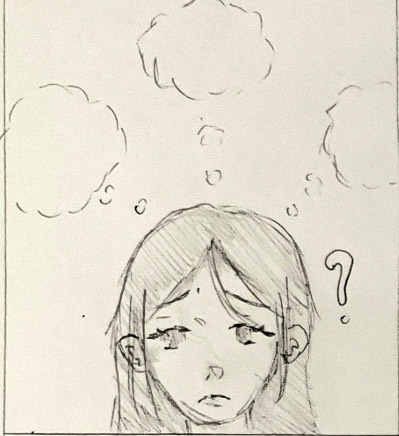
The second image representing thinking and communicating with clarity and precision shows a girl with empty thought bubbles surrounding her with a question mark. I chose to draw this to depict They Called Us Enemy because the characters are continuously met with ultimatums and difficult situations where they need to make a choice to determine the wellbeing of their families.
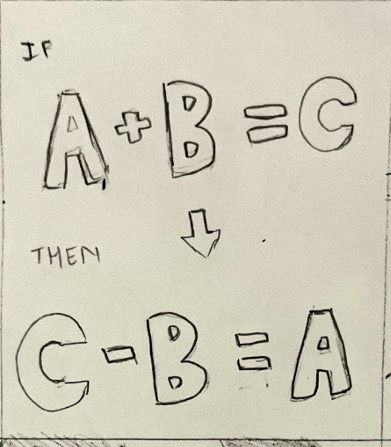
The third image representing applying past knowledge to new situations is a reference to the communitive property in math because it shows how we can use what is given to find out what we can about the unknown. This skill is utilized a lot by the father of the Takei family because he is seen as the head of the family. He takes initiative in trying to improve their community’s living situation. This leads to the responsibility of figuring out the best course of action to take using his experience of living in an internment camp.
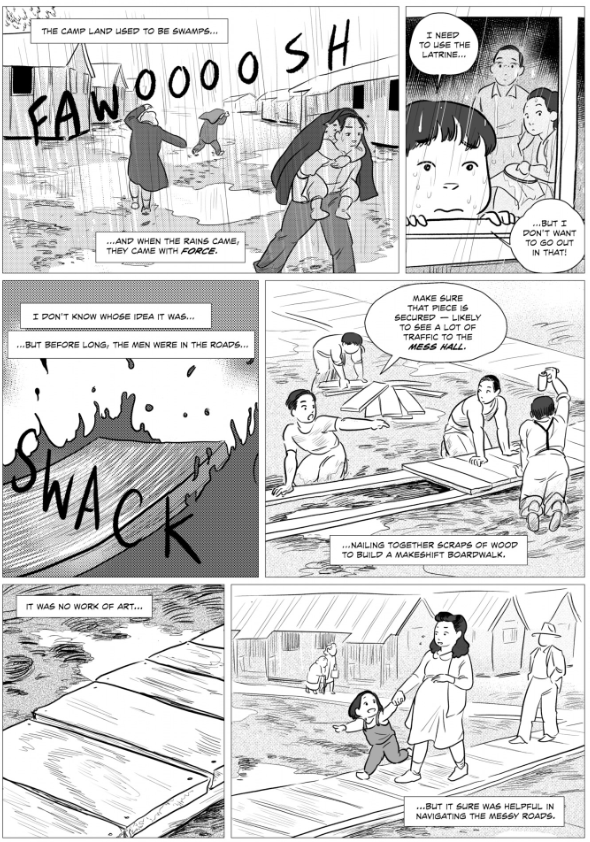
The continuation of racism from the past following minority communities proves how history can never be erased and will continue to haunt people of color through ignorant comments and actions even if they’re not made consciously. These microaggressions reflect the setting many Asian immigrants had to grow up in when they gave up everything in hopes of building a brighter tomorrow in America. The “American Dream” gives hope to the idea that anyone can achieve success no matter where they come from or how much money they have. For many minorities, this ideology can be impossible to achieve because there are other factors besides hard- work and determination that lead to our success in an American society. However, racial minorities continue to fight, adapt, and overcome these adversities because that’s what we had to do for generations to survive in America.
 Write Our World