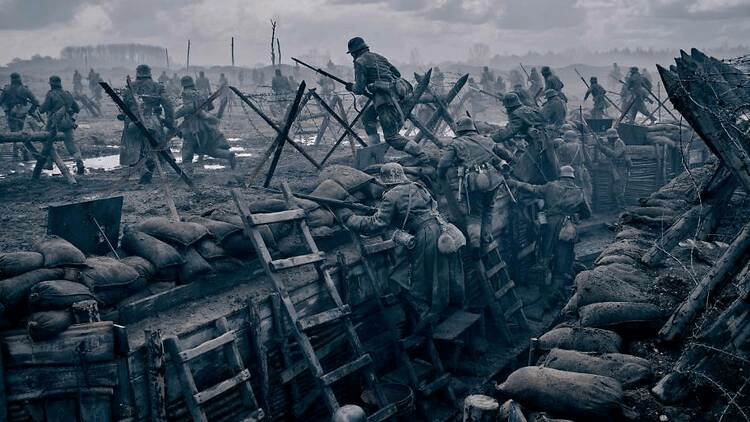
Actions that impose both the good and bad are often either justified or rejected by society, despite the opposite perspective. The novel All Quiet on the Western Front by Erich Remarque, where moments are filled with agony and distress but also unusual warmth, delivers strong feelings of disconcertment to the audience as times of struggle seem to awfully last longer than the fleeting peaceful times. The main character, Paul Baumer, and his fellow friends are as if naturally grown to be loved and sympathized by people—those who fearfully hope that their beloved characters with captivating traits and depressing experience in World War I would not go through the painful and permanent thing called death. And although they are especially loved for their brave and impactful actions, which could be seen as ultimately positive and righteous from one side, what has been blinded are the may-be faults in these actions itself. Similarly, on the other hand, characters that show apathy and indifference are frowned upon as their actions seem so cold-hearted and vile; yet, looking further into it, their purposes and intentions may rather be valid.
Where there is good, there is also bad; and vice versa. The philosophy of Dissoi Logoi asserts that a two-fold argument—in which the opposing aspects of an action that would usually give rise to controversies—is bound to be derived as they both reasonably and realistically coexist. This concept, being prompted by an unknown philosopher, states that “the same thing is good for some but bad for others, or at one time good and at another time bad for the same person” (Robinson 48). This simply means that an idea or physical object in existence can affect different people or the same person in various ways. Thus, with obscure and complex personalities, while the actions of the soldiers are viewed to strictly be good or bad on the surface, contrasting aspects can stem from these very actions corresponding to the two-fold argument concept of Dissoi Logoi.
Before Paul and his friends are sent to fight on the frontlines, they are trained in a boot camp by Corporal Himmelstoss—a stern and harsh man who “had the reputation of being the strictest disciplinarian in the camp, and [he] was proud of it” (23). Being a shameless man who continuously orders his subordinates around for personal uses, he becomes one whom all the characters despise most. For instance, Paul has “remade his bed fourteen times in one morning,” where “each time [Himmelstoss] had some fault to find and pulled it to pieces;” and each day, he is given another ridiculous task that increases his infuriation (23). This provides an idea of the unpleasant character of Himmelstoss as he torments Paul and his friends with ill treatment. Stanislaus Katczinsky, one of Paul’s closest companions, has brought up the fact that “the mischief is merely that one has too much power…[and while] they always do [require discipline]…it oughtn’t to become an abuse” (44-45). This shows that it is a must for a person to have power over another in order to maintain control, but Himmelstoss’ flaw is that he takes advantage of it and turns it into oppression. As terrible as a boot camp can be, having a corporal like Himmelstoss makes the experience worse. However, according to the philosophy of Dissoi Logoi, looking at the positive perspective, his actions also create a sense of reality when it comes to war.
When Paul enters the fast-moving battlefield, the conditions will certainly not improve. Instead, the circumstances would be much more dull and gruesome; therefore, it is an important aspect that going through Himmelstoss’ tough and abusive training allows Paul and his friends to prepare for the real war, where receiving subtle wounds are common and fatal. They became “hard, suspicious, pitiless, vicious, tough—and that was good; for these attributes were just what [they] lacked” (26). Furthermore, had they “gone into the trenches without this period of training most of [them] would certainly have gone mad” (26). This suggests that despite all the hatred they have developed towards the ill-natured corporal, there are no regrets as they go through the camp. Corporal Himmelstoss will always be the living nightmare of the recruits as he orders them around with barely any breathing space for the soldiers; yet, the conditioning he provided proves to be quite useful, allowing Paul and his friends to enter the frontline with more confidence and a stronger mentality. Thus, this fulfills the proponents of Dissoi Logoi where an action can be bad and good in certain ways for the same group of people—the actions of Himmelstoss may physically torment recruits, but they also prepare them for war.
Many soldiers are, to a certain extent, forced to engage in the war as staying on the homefront is considered to be an act of cowardice. But on the frontline, where exhaustion often kicks in with loud bombshells and explosions that appear to never end, sleep becomes such a rarity that it becomes a privilege to be able to temporarily drift away from the grim reality. With violent warfare relying on alertness and human instinct, energy must quickly be regained; and if not by sleep, then food would be the main source. Naturally, food comes off as scarce, a treasure of which a person could only receive from little to none at all. It becomes a soldier’s main desire to have his stomach full as he consumes his daily delightful meal. For this reason, at the end of Chapter 5, Paul and Kat head back to the regimental headquarters’ shed and steal a goose, which they kindle a fire and roast it. As soldiers they are hungry, but not greedy and defined by gluttony, as shown by them bringing back a portion for Kropp and Tjaden, who could not believe their eyes while taking Paul and Kat for “magicians.” Tjaden, a character known for his love for eating, “holds a wing in his mouth with both hands like a mouth-organ, and gnaws [on the meat]” as he says, “May I never forget you” (96). This not only displays the morals of the two characters by their unselfish nature, but it also gives an idea of extreme hunger during World War I. It is a small yet fulfilling meal for them, considering how little of a portion they receive each day as food; hence, a great benefit they have gained. However, this action does not positively account for other people who also suffer from hunger.
Warfare leads to inevitable starvation from many different factors, such as “[ravages of] war and naval blockades [that] reduced food imports” (Rationing and Food Shortages). Therefore, not only does the frontline lack a nourishing meal, but also the homefront. This can be noticed when Paul receives a leave for fourteen days and returns home, where he brings back food and inquires his sister about the current hunger condition, to which she replied that “there’s not much [here]” (160). This shows that while there are people not suffering from fighting the long-lasting war, they still experience certain struggles, especially in the case of food. For this reason, stealing food in a time where almost everyone lacks it can be, from the perspective of those who do not benefit, unfair and self-serving. Moreover, as mentioned earlier, the goose belongs to the regimental headquarters—while the animal may be served for the higher ranks who are more prioritized, it could also be saved for the troops’ cookhouses, where the meat shall be divided into rations for each person. Thus, this correlates to the idea of a two-fold argument, stating the good of an action for one person, but bad for another; Paul and Kat stealing livestock satisfies their hunger along with their friends, but it also means the loss of food storage of another group of people.
World War I is a period of darkness that paints a large picture showing countless deaths and suffering. With the desperation to live, everything is fast-paced. As one lets down their guard for one moment, it could lead to one’s demise, that even a well-trained soldier is still in a vulnerable position. And as unfortunate as it is, a young soldier who has just entered the frontline can receive a deadly wound in an instant, with not yet a life to experience—one as such is Franz Kemmerich, a former classmate of Paul who dies from a leg wound that is so fatal that amputating it cannot save him. For a person to meet his end before being able to fulfill life is depressing; but even more so, to go through a slow, painful death..
With a “ghastly, yellow and wan” look, and “under the skin the life no longer pulses,” Kemmerich and everyone else knew that his “death is working through from within” (14). Yet, there is a lingering false hope that he would get better and have a chance at life. Needless to say, Paul who has been implored by Kemmerich’s mother to look after him, feels an urge to not reveal the whole truth as he visits her in Chapter 7. Paul tells her that “he was shot through the heart and died instantaneously,” for she is already a “quaking, sobbing woman;” and her worries and pain would have surged, had she known the entire truth (180). Paul did not want that to happen as he does pity her. This is an instance of where lying at certain times can lead to a better end; nonetheless, as stated by the philosophy of Dissoi Logoi, Paul’s decision that lessens Mrs. Kemmerich’s sorrow can also be negative in another aspect.
While a person may not be aware of it, it is an invisible agony to live one’s life believing a lie as one cannot help it either. Miserably, Mrs. Kemmerich feels the inclination to doubt Paul’s words, and in a way, she has a feeling that her own son had died a rather more painful death. She weeps, “You lie. I know better. I have felt how terribly he died…you must tell me. I know you want to comfort me, but don’t you see, you torment me far more than if you told me the truth? I cannot bear the uncertainty” (180-181). This depicts the emotions of a person in doubt, who is, in some way, aware that their is a patchwork of lies within Paul’s words; but as he continues to be dishonest with only the audience to truly know what had happened, it is like torture where she is trapped under the unsettling grey sky with no power to escape—she would be stuck there, never seeing the wishful blue sky, until she meets her end. Therefore, in one aspect, it may be better for Mrs. Kemmerich to continue living with less suffering, thinking that her son at least died without much pain; on the other hand, in another perspective, she is living the rest of her life in a complete lie, and it may have been better for her to learn the truth and hopefully accept it.
Overall, at first glance, Himmelstoss’ actions seem to be solely abusive and unfair to his recruits, while Paul and Kat stealing a goose for food and Paul minimizing Mrs. Kemmerich’s grief by lying are justified for their good purposes. However, through the philosophical lens of Dissoi Logoi, the harsh training of Himmelstoss can be viewed positively as it prepares the soldiers for the actual war front. It also points out the negative aspect of stealing food, that despite Paul and Kat’s suffering out in the war with hunger, it is still unfair to those who are also experiencing starvation. Moreover, Paul’s choice of persistently lying to Mrs. Kemmerich rather promotes an underlying side of torment as she will never learn the entire truth behind her son’s death. Therefore, based on the concept of a two-fold argument, an action can affect different people or the same person in different ways. But ultimately, whether or not the good in it outweighs the bad entirely depends on one’s own perspective, for “some say that what is good and what is bad are two different things, others that they are the same thing” (Robinson 48).
 Write Our World