Jean-Paul Sartre was a prominent philosopher in the 20th century who was known for his existentialist views. According to Sartre, human beings are free and responsible for their actions, and their existence precedes their essence. This means that individuals must create their own meaning and purpose in life through their choices and actions. These ideas can be applied to the morality of killing others during World War I, as depicted in Erich Maria Remarque’s novel All Quiet on the Western Front.
The novel follows the experiences of Paul Baumer, a young German soldier who fights in World War I. Throughout the book, he witnesses the horrors of war and the devastating effects it has on both himself and his comrades. He also struggles with questions about the morality of killing others and the purpose of the war. These themes are central to Sartre’s philosophy of existentialism, which emphasizes individual responsibility and choice.
One of the most powerful quotes from the novel that highlights the disconnect between the soldiers and the leaders who sent them to war is, “While they taught that duty to one’s country is the greatest thing, we already knew that death-throes are stronger” (Chapter 1, pg. 13). This quote suggests that the soldiers have a deeper understanding of the true nature of war than their leaders. The idea of duty to one’s country is presented as a false and shallow concept, while the reality of death and suffering is much stronger and more profound.
This idea can be linked to Sartre’s existentialist views on responsibility and choice. According to Sartre, individuals are responsible for their actions, and they must take responsibility for the consequences of those actions. This applies to the leaders who sent the soldiers to war as well as the soldiers themselves. Both parties must take responsibility for the suffering and death that results from their actions. This was not done by the leaders at the top as they were not immersed into the war, but instead stood at the sideline coaching. No sympathy was given as the people at the top were not touched by anyone.
Another important theme in the novel is the idea of seeing the enemy as a fellow human being rather than an enemy. This is highlighted in the quote, “A word of command has made these silent figures our enemies; a word of command might transform them into our friends” (Chapter 8, pg. 193-194). This quote suggests that the soldiers on both sides of the conflict are essentially the same, and that it is only the commands of their leaders that have made them enemies.
This idea is also present in Sartre’s philosophy of existentialism. According to Sartre, human beings are fundamentally free, and they must take responsibility for their choices and actions. This includes the choice to see others as either enemies or friends. The soldiers in the novel are forced to confront the reality that their enemies are not so different from themselves and that the lines between friend and enemy are not as clear-cut as they once thought.
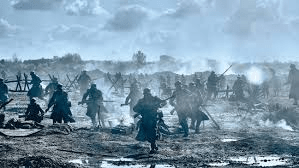
Finally, the novel raises questions about the value of life and the morality of killing others. This is highlighted in the quote, “We are not youth any longer. We don’t want to take the world by storm. We are fleeing. We fly from ourselves. From our life. We were eighteen and had begun to love life and the world; and we had to shoot it to pieces” (Chapter 5, pg. 88). This quote suggests that the soldiers in the novel are forced to kill not only their enemies but also their own sense of purpose and meaning in life.
This idea is central to Sartre’s philosophy of existentialism. According to Sartre, individuals must create their own meaning and purpose in life, and this requires making choices and taking responsibility for those choices. The soldiers in the novel are unable to have a sense of individual freedom as their actions and choices do not belong to them. It is mentioned multiple times in the novel that Paul and his friends don’t have lives outside of war. All they know is war and their life is controlled by it.
In conclusion, the philosophy of Jean-Paul Sartre can be applied to evaluate the morality of killing others during World War I and the ethics depicted in the novel All Quiet on the Western Front. Sartre’s philosophy stresses the importance of individual freedom and responsibility, and how this freedom can be constrained by external factors such as social norms and institutions. Remarque’s novel portrays the experiences of soldiers during World War I, and highlights the senseless violence and destruction of war, as well as the psychological toll it takes on individuals.
 Write Our World