Erich Maria Remarque’s novel All Quiet on the Western Front depicts the harsh and brutal realities of World War I through the perspective of Paul Bäumer, a 19-year-old soldier who volunteers for the war with his friends. Throughout the novel, Paul faces numerous ethical dilemmas and struggles to reconcile his experiences with his sense of morality. This essay will evaluate Paul’s behaviors using the philosophy of the Christian Gospel, specifically drawing on quotes and passages from the books of Matthew, Luke, Mark, and John.
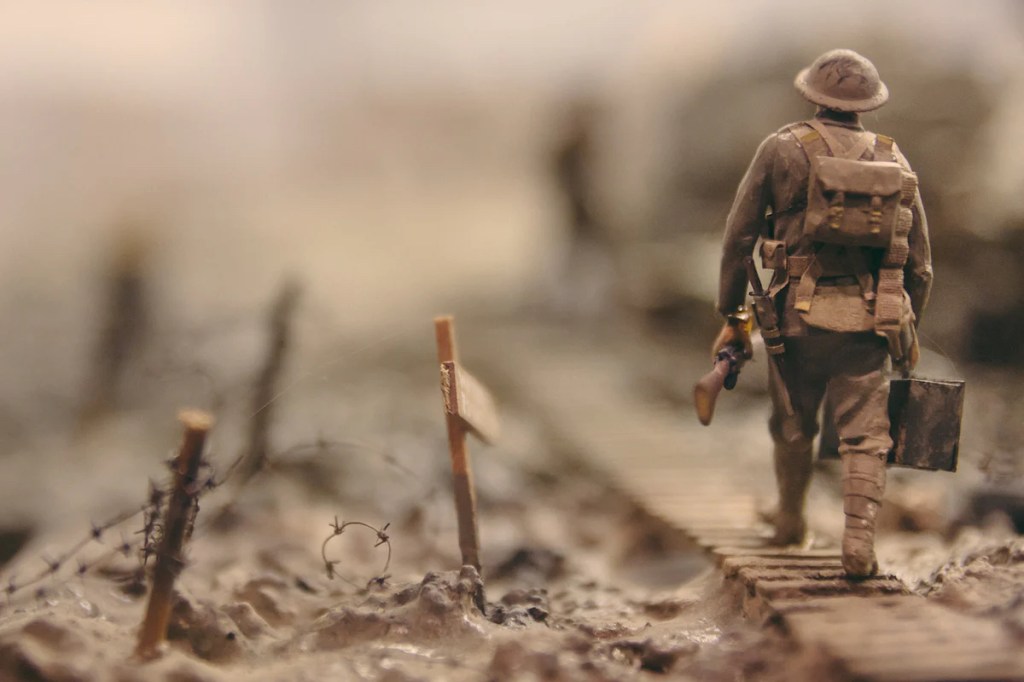
Overall, Paul is depicted as a caring and compassionate person who values brotherhood and friendship. He comforts his friend Kemmerich by telling him that he will be going home soon, even though he is unsure of what is coming next. Paul expresses, “Besides, you will be going home…” “Do you think so?” “Of course” (27). This shows that Paul helps his friends stay hopeful, even through tough times. He also performs acts of service for his mother out of love for her. For example, when he goes home, he spends quality time with her shown through the quote, “And so I take her to her room. I stay with her for a little while” (184). This sense of empathy and care for others aligns with the Christian Gospel’s teachings, such as Luke 6:31: “Do to others as you would have them do to you.” In this regard, Paul’s ethics are admirable as Paul treats others with the same understanding and comfort that he would want if he were in their position.

Although Paul displays commendable behavior, his experiences in the war often force him to compromise his morality. For example, he and his friends beat up Himmelstoss because of what he did to Tjaden, which could be seen as an act of vengeance. The novel explains, “…Himmelstoss on the ground; Haie bending over him with a fiendish grin and his mouth open with bloodlust, Himmelstoss’s head on his knees…” (49). While these actions could be justified as acts of self-defense or protection, they go against the Christian Gospel’s teachings of non-violence. To add to Paul’s corrupt behavior, Paul also lies to people, including Kemmerich’s mother shown through the quotes, “Are you willing never to come back yourself, if it isn’t true?” “May I never come back if he wasn’t killed instantaneously” “…so I invent a story and I almost believe it myself” (181). Paul told Kemmerich’s mother that Kemmerich died instantaneously, while in reality he actually died painfully slowly. This lie demonstrates Paul’s willingness to deceive others to make them feel better, even if it means distorting the truth. The Bible verse, “If we claim to have fellowship with him and yet walk in the darkness, we lie and do not live out the truth. John 1:6,” suggests that Paul’s actions are not in line with Christian philosophy. In the novel, Paul also kills someone, “…I strike madly at home, and feel only how the body suddenly convulses, then becomes limp, and collapses” (216). According to the Bible, this shows immoral behavior as the verse, “You shall not murder, and anyone who murders will be subject to judgment. Matthew 5:21,” highlights the moral wrongness of Paul’s killing of an enemy soldier, even if it is for self-defense. Generally, Paul’s actions illustrate his descent into the darkness of war and demonstrate how the horrors of it can corrupt even the most moral individuals.

However, Paul’s moral struggles do not make him an entirely bad person. In fact, his guilt and remorse for his actions show that he is still capable of self-reflection and empathy. Throughout the novel, Paul holds an inner monologue about how the hatred between human beings started in the first place to make a war of this magnitude became possible. A quote that represents one of the multiple times Paul has had this realization is, “…’there would not have been a war if the Kaiser had said No” (203). This shows that Paul realizes the war started because of only a couple of people and questions the point behind it. A time Paul acted upon his feelings was when he gave Russian prisoners, his enemies, food because they were starving to death. Paul did not need to do this as the situation occurring was telling him this was who he was supposed to be against. Besides this, Paul still thinks of the prisoners as people, “It is strange to see these enemies of ours so close up…honest peasant faces” (190). This aligns with the Christian Gospel’s teachings of love and forgiveness, as seen in Luke 6:27-28: “Love your enemies, do good to those who hate you, bless those who curse you, pray for those who mistreat you.”

To conclude, Paul’s ethics and morality in All Quiet on the Western Front are complex and multi-faceted, reflecting the difficult realities of war. While he often compromises his morality to survive, he also shows empathy and compassion towards others. Through the lens of the Christian Gospel, we can see both admirable and problematic aspects of Paul’s ethics. Overall, his struggles highlight the moral ambiguity of war and the importance of reflection and self-awareness during trying times.
Works Cited
Remarque, Erich Maria. All Quiet on the Western Front. Ballantine Books, 1982.
The Holy Bible, New International Version. Zondervan, 2011.
 Write Our World