Evaluating the ethics of Paul, a soldier in Erich Maria Remarque’s All Quiet on the Western Front, through the lens of John Stuart Mill’s philosophy yields compelling insights into the nature of human conduct. Mill’s assertion that “the promotion of [happiness] the test by which to judge of all human conduct” is particularly relevant when considering Paul’s experiences during the war. Despite being conscripted to fight, Paul is deeply critical of the concept of war itself and laments the arbitrary hatred that divides soldiers based on their uniforms. As he reflects, “I see how peoples are set against one another, and in silence, unknowingly, foolishly, obediently, innocently slay one another” (Chapter 4).
Paul’s compassion towards his fellow human beings is evident throughout the novel. In one instance, he attempts to aid an enemy soldier he has just wounded, recognizing that the soldier is, like himself, a human being caught up in the horrors of war. As Paul reflects, “I see him in mortal agony. I try to staunch the flow of blood, but it is impossible. The blood spurts from the wound, so red and so much that it seems impossible to retain it within the body” (Chapter 9). This act of kindness towards an enemy combatant is a testament to Paul’s belief that the arbitrary distinctions between different nations and peoples are fundamentally meaningless.
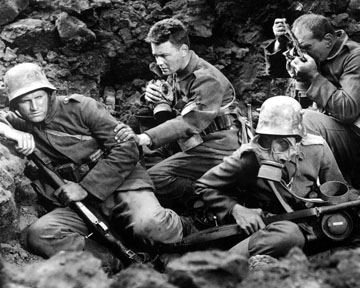
At the same time, Paul’s loyalty to his friends and family is equally evident. When his comrade Katczinsky is gravely wounded, Paul does everything in his power to ensure that he receives medical attention, with full belief that he can save his life. As he reflects on his friend’s fate, Paul muses that “Kat has been killed like a recruit… He was young, fresher than I. Why did they do that to him? Wars, battles, slaughter… This our sacrifice on the altar of the great illusion” (Chapter 11). In this moment, Paul grapples with the senseless violence that has claimed the lives of countless young men like himself and Katczinsky, recognizing that the war is nothing more than a pointless bloodbath that has robbed them of their youth, innocence, and vitality.
Despite his many admirable qualities, Paul is not without flaws. He lies to the mother of his deceased comrade, Kemmerich, about the circumstances of her son’s death, unwilling to tell her that Kemmerich’s leg had been amputated before he died. In doing so, Paul recognizes that he is not only shielding Kemmerich’s mother from the truth but also himself from the guilt and shame of his own complicity in Kemmerich’s death. As he reflects, “I would have liked to tell her that he died a hero’s death, but I’m incapable of uttering falsehoods. I said he had died immediately. She looked at me, her eyes veiled. I felt very awkward and offered my condolences again” (Chapter 7). This lie deprives her of the truth and denies her the opportunity to grieve properly.
In conclusion, John Stuart Mill’s philosophy provides a valuable framework for evaluating the complex ethical and moral questions raised by All Quiet on the Western Front. Through the character of Paul, Remarque offers a searing indictment of the dehumanizing effects of war and the arbitrary distinctions that divide us as human beings. Yet, despite the horrors he witnesses and the suffering he endures, Paul remains a fundamentally compassionate and empathetic individual, demonstrating that even in the midst of the most appalling violence, there is always the possibility of human connection and kindness.
By ChatGPT
 Write Our World