What you aren’t aware of can completely catch you off guard. Perhaps we should try taking a look at another perspective.
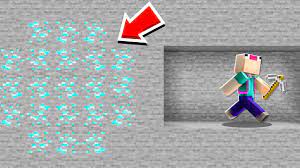
I cannot imagine where I would be if I had always stayed within my boundaries. Well, I’d be bounded of course, limited to what I know and with what I am comfortable with. If I never stepped out of my boundaries, my boundaries would’ve never expanded, and I would be living inside a small, made up reality with not many ideas or thoughts–the same reality that I’d have since I was born. But the truth is, our boundaries are bound to expand—we inevitably see things that a baby never saw; we crawl outside our cribs to explore the house because our brain tells us to do so. Exploration is how we grow as people, and it is a natural process.
At some point in life though, the expansion of our boundaries begin to decelerate. Our brains stop telling us to explore as we become complacent with the reality we have created. We think to ourselves that everything is good enough, that there is nothing we don’t know. We stop wanting to explore and learn, and that is damaging to our growth. We stop questioning the unknown, and we stop taking opportunities to make mistakes. Instead, we become afraid of the unknown and we try to avoid it whenever possible. Even saying “I don’t know” becomes hard. But mistakes are crucial to improvement, and there will always be room to be better than who you were yesterday. When we become too satisfied with what we know too early, we prevent ourselves from reaching our maximum potential, and we blind ourselves from the possibilities that can unfurl.
I was there when I was already too comfortable with the way things were. I probably still am there, and will be there for the rest of my life. The difference is that I wasn’t willing to be uncomfortable. Before 8th grade, I wanted to join the middle school orchestra. I wanted that because I’ve had experience with it, I knew the people there and I felt like I belonged. But my dad challenged me to try something new. He found out about the robotics elective and gave me the option to join it or sacrifice my video games for orchestra. As a middle-schooler who lived off video games, I really only had one choice. My dad’s argument was “You don’t know what you don’t know,” which is a statement that will resonate with me throughout my life. How could you reject something before you even knew what it was like? Yet we do it all the time. He said the same thing for everything new he wanted me to try.
Joining robotics changed my life in a way I cannot fully explain. I found part of myself through it; I discovered what I enjoyed and what I was good at. I met people who shared similar interests, people who inspired me to love learning. By stepping out of my comfort zone, I discovered a whole new world that was way better than the previous. I learned things that I didn’t even know existed. A step into the unknown is a chance to unlock new skills, new experiences, and evolve as a person; but for some reason, we stop believing that it is worth it.
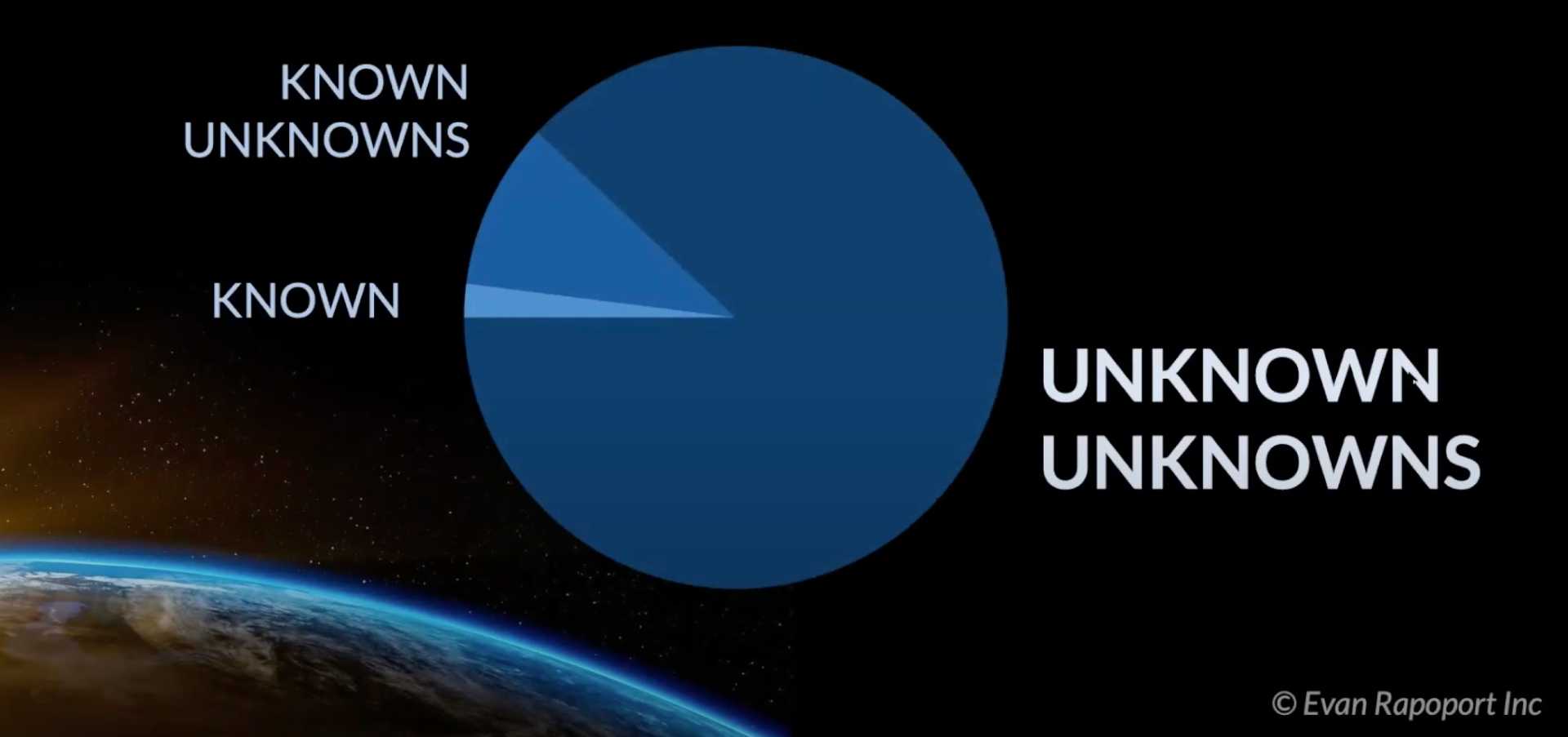
Anything can happen at any time, and it is hard to prepare for something without even having an idea of what is ahead of us. The unknown and hidden truth is everywhere, even laying right in front of our own eyes. Sometimes, dire consequences can result from not being open to the possibilities. In Shakespeare’s play Othello, everyone is completely oblivious to what the villain Iago is trying to accomplish. Spoiler: everyone dies. But there are ways to mitigate the risk of the ‘unknown unknowns’- the ‘things we don’t know we don’t know’ (Donald Rumsfeld). It is just a matter of being open to ideas and being willing to throw everything you thought you knew into the trash can. And it isn’t just about avoiding possible risks either; you will also discover new things and grow in the process. Given that anything can happen at any time, anyone can make the next big discovery!
For Othello, the unknown took him by surprise. You could say his status and power played a factor in his blindness. Power leads to arrogance: logically, the more you know, the more unlikely you are to doubt yourself. Because Othello held such a high position, he did not doubt his decisions; what he says is what happens. This blindness enabled Iago to manipulate him.
Iago is a perfect example of the unknown unknown amongst the other characters. He stays in an area that the others are completely oblivious to, working behind their backs to ultimately bring everything down. The others didn’t see Iago’s plan. They didn’t see the fragile stilts their world was balancing upon that Iago could cut down at any moment. If Othello had questioned Iago’s suspicion even though he seemed very truthful and loyal, things could have ended up differently. If Emilia questioned her husband about why he wanted Desdemona’s handkerchief, everyone could have lived.
The characters in the play also weren’t aware of how their little sins compounded in Iago’s favor. One principle I live by is the Edward Lorenz’s butterfly effect; could a flap of a butterfly’s wing lead to a slight inconsistency in the wind and end up as a tornado? In the case of their sins–yes. Emilia’s sin of omission (Othello Act III, Scene III) with the handkerchief enabled Iago to frame Cassio, eventually driving Othello mad and causing everyone to die. Cassio didn’t know that getting drunk for one night would end his reputation and also play a huge part in Iago’s plot (Othello Act II, Scene III). Most people aren’t aware of the butterfly effect; they don’t think about how their seemingly meaningless actions could possibly end up affecting others. They had no idea that all of this stuff was happening in the background. It is hidden in the realm of unknown unknowns, and that makes people susceptible from their own actions.
The Dunning Kruger Effect can better explain the concept of unknown unknowns. Dunning and Kruger stated in one research paper: “When people are incompetent in the strategies they adopt to achieve success and satisfaction, they suffer a dual burden: Not only do they reach erroneous conclusions and make unfortunate choices, but their incompetence robs them of the ability to realize it.” In other words, dumb people are dumb because they aren’t able to notice that they are dumb. There is a term for this concept as well: anosognosia. Anosognosia is a condition in which a person who suffers from a disability seems unaware of or denies the existence of his or her disability (The Anosognosic’s Dilemma, footnote #11). Although it is a medical term, the idea can be applied to anyone in the sense that there is always room for improvement, but for some reason we aren’t always improving.
Recently in my chemistry class, we learned about how the atomic model we have today was developed. Let’s go back to the discovery of the nucleus. For months, Ernest Rutherford directed his assistants to record positively charged alpha particles passing through a thin sheet of gold foil. They put the detector on the opposite side from the source of radiation with the foil in between, and the electrons hit the detector as expected, passing through the gold atoms. But then one day, Rutherford said to give it a try putting the detector on the same side of the radiation, just for the heck of it. They didn’t expect it to detect anything since the alpha particles were aimed away from the detector, but they tried it anyway. To their surprise, they discovered that very few of the particles bounced directly back, leading to the discovery of a small, dense, positively charged nucleus inside an atom composed of mostly empty space. This scientific breakthrough was due to Rutherford’s curiosity and knowledge that there is a chance that something doesn’t go the way we expect it to; that sometimes things aren’t as they appear to be. What we see is never the full truth.

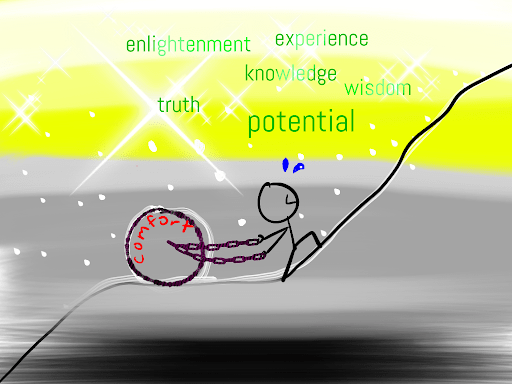
My dad is a very wise man. He was the one to loosen the chains of comfort that held me back from my potential. It is very hard to willingly put yourself in uncomfortable situations. It truly is. That is why sometimes you need someone to push you, someone who can see from many points of view and mentor you to take action. It doesn’t have to be one person from your family either; the more people you have that can provide feedback, the better. But be careful with who you trust; you don’t want someone like Iago to control you from behind the scenes. Peer pressure can be used as a weapon of mass destruction or a cure.
The story of the Mojave Phone Booth is another great example of stepping into the unknown. Calling the mysterious phone booth everyday out of pure curiosity, waiting for someone to pick up the who-even-knows-exists phone was like jumping into a pitch black chasm. It was unlikely anyone would ever pick up. But the thought ‘what if someone did pick up?’ was intriguing enough to try it. And, just like the discovery of the nucleus, the caller found someone on the other side of the line; they found treasure at the bottom of the seemingly endless chasm.
I guess the best way (in my experience since I don’t have many friends to give me perspective) is to be proactive and face the unknown first before the unknown unexpectedly finds its way to you. But before you do any of that, one must acknowledge that there are things they never have imagined before out there in the world. They must accept that there are things they don’t even know exist. From there, they can try to have a more open mindset and try new things.
I like to think of the known unknowns as the “what” questions. They can mostly be answered with facts and other things we know. The unknown unknowns are the “what ifs,” and there can be infinitely many solutions to the question. One strategy I use is to think of a positive ‘what if’ outcome for the situation I’m about to step into. After I have envisioned a possible reward, I take action based on optimism I created for myself. Curiosity is the key to learning. We probably have all heard the phrase “curiosity killed the cat,” but what I would say instead is “curiosity kindled the cat” (I used kindled as a synonym for enlightened).
Stepping into the unknown is like a search for aliens. Run into the dark forest to see what you can find. Kids like to explore a lot with their imagination, and it may seem stupid. But I tell you, looking behind every single tree to see if there is a portal to another world is not stupid. There just might be something you will find that no one has ever seen before.

 Write Our World