
Have you ever watched a movie, or a TV show, and there was a character that was clearly the villain, but the characters didn’t know that the character was the villain before it was too late? I’ve been there many, many times. This situation doesn’t just happen in Film or TV, it can also happen in books, or musicals/plays as well! This is clearly a situation of dramatic irony in which we know something the characters don’t. Two villains that fit the situation of the audience knowing who the villain is would be Iago from William Shakespheares Othello and Mother Gothel from Disney’s Tangled. The two characters are raising oatmeal cookies. They seem to be a sweet, and lovable chocolate chip cookie, but once they are bitten, you come to realize those were not chocolate chips, but raisins. The antagonists have similar ways of lying to the characters around them, even if they did it in different matters.
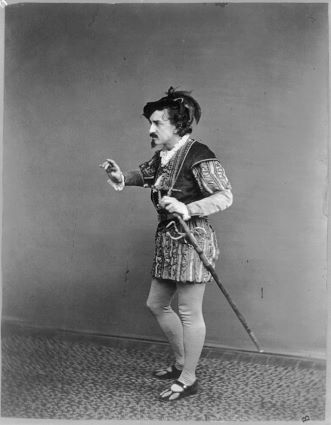
Iago
Iago from William Shakespeare’s Othello
In the play Othello by William Shakespeare, the character Iago is the main antagonist. He is lying to everyone’s face, and manipulating them. He lies to his friends, his boss, his wife, etc. We, the audience, know he is manipulating and lying to everyone’s face, and nobody in the play suspects a thing, yet the readers know what’s actually going on. In the film Tangled, we the audience know very well that Mother Gothel is the villain, but Rapunzel does not know that. She lives her whole life thinking Gothel is her mother and actually cares about her, but we the audience know Gothel does NOT care about her and only wants her for her powers. What do these two villains have in common, besides them obviously being the villain the protagonist doesn’t know about? One way that these villains relate is that they manipulate the thoughts and judgments of other characters. Iago manipulates many people’s judgment in the play, such as Othello, making him think Desdemona was having an affair with Cassio. Manipulation and lying is a major theme or idea in Othello, showing its audience that some people in life are not who they seem to be. Similar to that, Gothel manipulates Rapunzel’s judgment of the outside world, saying that it is dangerous and that people will come for her and her power. Not only do the two villains just say, but they also show. Iago sets up all this evidence to prove his lie of Desdomona cheating on Othello by hiding Desdemona’s handkerchief in Cassio’s place. Gothel proves her lies by recruiting two thieves who “attempt” to kidnap Rapunzel, but Gothel stages a rescue, plus she sends Rapunzel’s love interest to jail, but staged it as if he left her behind. Both these characters have a lie that they set up with evidence. They put the idea in the Protagonist’s head, and then spew out all of this false evidence made by them, making the Protagonist believe these lies, but as the audience, we KNOW that this is all false. Both of these two show to us, the audience, that they are liars.
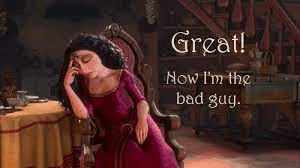
Mother Gothel in Disney’s Tangled
Knowing that these two antagonists are liars and are manipulative, you tend to think, how do the other characters around them believe this stuff? How did Iago get Roderigo to trust him so much that he gives his own money to Iago despite the fact that Desdomona still had no interest in him? How did Mother Gothel get Rapunzel to believe she was her mother despite the fact that there were floating lanterns that always showed up on her birthday? They both clearly used manipulation, specifically emotional manipulation. According to Dr Harold Hong , Emotional Manipulation is defined as, “a form of psychological manipulation in which a person seeks to control another person’s emotions. It is often done through persuasion, coercion, or even emotional blackmail.” . Looking at emotional manipulation, tactics included are, “Lying, denying, passive aggressive behavior, gaslighting, criticizing, withholding, blaming, and getting somebody out of their comfort zone.” Some of these symptoms are both seen in Iago and Mother Gothel. For Iago’s situation, he lied, obviously, but also got Cassio out of his comfort zone. He encouraged Cassio to get drunk, which led to Cassio to get fired, and that led to a whole domino effect of he said she said and also resulted in multiple deaths. For Mother Gothel’s situation, she also lied, obviously, but she also displayed Gaslighting. During a scene with Rapunzel, Gothel lashes out at Rapunzel for expressing how she thinks she is capable of handling the real world. First, Gothel constantly doubts Rapunzel’s ability before shouting at her, that could possibly count for criticizing. After she shouts at Rapunzel, Gothel says, “Great, now I’m the bad guy.” in a sarcastic tone. This clearly makes Rapunzel feel bad as if she has done something wrong. Both of these characters use emotional manipulation to get their way with no regards for who is affected, even if trust is broken, because they don’t care about that, they only want their objectives.
These two antagonists clearly formed trust with characters around them and broke it to their advantage. For Iago, it was everyone in the play, and for Gothel it was Rapunzel. According to Dante’s Inferno, the eighth circle of hell is for those who are frauds. It is divided into ten ditches, including punishment for Flatterers, barraters, soothsayers, hypocrites, thieves and robbers, evil counselors, troublemakers, and falsifiers. Looking back at Iago and Gothel, they clearly classify well with the eighth circle of hell. Iago would very much go into the tenth ditch. The tenth ditch is for liars and any other kind of falsifiers. There he would be subjected to the ailments of his actions. For Mother Gothel, she could be in the tenth ditch, however she could land in ditch 7 where she would be subjected to a pit of snakes. Either way, they could both be in the eighth circle, just different ditches, or possibly the same one, their sins did involve lying and manipulation.

Dante’s eighth circle of hell
In all, these two characters were very bad people to those around them and we as the audience were only able to see them in action. We see how they emotionally manipulate characters around them using tactics seen in emotional manipulation. We know the types of lying they did, what category of hell they would be in. We know what they are.
 Write Our World