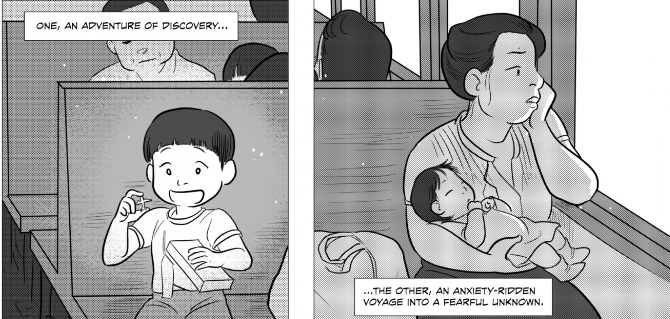
I noticed that throughout the graphic novel They Called Us Enemy, George’s view of the world as a kid was much different compared to his parents. It made me realize how as we grow up, we gradually lose a lot of the charismatic and adaptable traits we had as a kid and it makes me wonder if it’s because we didn’t know what struggles the world would bring as we grow.
Even though George and his siblings weren’t living in their actual homes and had to make the most of unpleasant and unpredictable conditions, they saw it as normal. I believe it’s because their parents made it seem like nothing was wrong and George knew nothing more, though the reader and George in the future looking back at it now see that there was something tremendously wrong with it all along. I think another example is when George was told to yell “Sakana Beach” at the guards by kids older than him; he didn’t know what it really meant. It’s painful but also insightful growing up and looking back at what we went through as a kid and how we got through it. It makes me wonder if it really is just better to not know some things for our own mental sake.
Now, I find myself wanting to know every detail of everything that happens, even secrets and discussions that are meant to be private, and I find that it does take a negative toll on me.
Another thing that I learned while reading the graphic novel is how well the people who were forced to live in the internment camps got along together and made communities. It was mostly seen in the internment camps in Arkansas, the first one George went to, but it was also seen in the second camp where people grouped to form riots and fought for their voice together.
I think what helped achieve that is the fact that they all had the same thing that they were going through and therefore they understood that it’s important to be together throughout those hardships. It shows how great people can be, contrasting the fact that the government treated them in unprejudiced ways, if they all put their minds together to form a positive thing. Not only is it seen in this graphic novel that the people in the internment camps were trying to make changes, but also the activists mentioned throughout it like Martin Luther King and Wayne Collins, the attorney that helped George’s family.
I can understand why George’s father said that America has the best democratic government because people can do great things. However, when things become too overwhelming and everyone is mad about one thing or another, it does make people turn on each other and make it difficult to get along. I guess that’s why it’s important to reflect and find a way to change hard situations and maybe make the most out of it.
We’re all human, after all.

This graphic novel also taught me about leadership and responsibility and how those two things are important and tie into each other. It was president Roosevelt’s responsibility to protect and make sure that American citizens obtain justice and equality, but it was irresponsible of him to place Japanese heritage American citizens into internment camps because of his hysteria.
These were people who were American citizens and contributed to the country; there was nothing wrong with them. And it makes me think, if I had the leadership role as a president during this time, what would I have done? How would I have approached the bombing of Pearl Harbor? Those who were put in the internment camps were targeted and all their futures were under the president’s hands, but also a lot of people were harmed during Pearl Harbor. How would I make up for all those loses?
Something else that showed leadership and responsibility was George’s father being the block manager and how he still chose to be the manager of the people finding where to live after the occurrence of internment camps. People will look up to you if you are a leader, such as how people might’ve looked up to President Roosevelt’s decision to place people in internment camps, even if it wasn’t right. It’s also how George looked up to his father because he was a leader of the interment camp block.
I think part of the reason that George got such an important role in Star Trek and the ability to have confidence and perseverance was because of his father. George really wanted that role so he worked for that role and it was his responsibility to be good at it.
This lead to so many open doors and opportunities.
 Write Our World