My parents think that their stories of seeking life in America are too redundant, but little do they realize that sharing their history is preserving the past for future generations. I cannot let their journeys end when people need to know what happened during that time of their past. As I read the graphic novel They Called Us Enemy, I was heavily reminded of my parents and the tales I grew up hearing from them, but I realized that I still don’t know enough. My parents never found it necessary to go into detail about their upbringing because “the past is past” and “we should focus on our better future.” Although many first-generation Americans like me have probably heard similar stories as the ones my parents have told, I firmly believe that it’s important to never stop sharing these experiences because it creates a powerful sense of community, just like how They Called Us Enemy did for me as a reader. This is Ly Chinh and Thanh Sơn’s story.
My mother Chinh was nine years old when she first came to the U.S. It was April 20th of 1975, nearing the end of the Vietnam War. Saigon fell about ten days after her departure. People were running for their lives at the airport, stampeding and running over each other. It was everyone for themselves. A total of fourteen family members and my mother were supposed to leave by boat, which to their unbeknownst luck could not fit all of them (going by boat was extremely dangerous because the routes to Guam had to pass through pirates). Her grandfather was an entertainer for the American soldiers in Vietnam, and through their lucky connections, her family was able to be crammed onto a plane just before it left the outskirts of Vietnam, and headed for Guam—one of the many islands just outside of America with camps to stash the immigrants. For six months, every morning she would get out of her tent, stand in line waiting for a grim plate of breakfast, and wait for what the Americans would decide to do with them. “We were scared. I didn’t want them to get rid of me. We didn’t know what they wanted from us, what they were going to do with us. They could discard us or send us to another camp overnight. We were waiting for someone to sponsor us and take us in so that we could leave,” Chinh recalls.
Born out of wedlock and an only child, Chinh was taken in by her grandmother when her mother passed away early on in Chinh’s childhood. “I remember crying and pleading to not leave my grandmother. No one could understand us.” Alone and helpless, they were dropped into a foreign atmosphere. From what Chinh remembers, there was always tension between the soldiers no matter how accommodating they were to the refugees. As a child, it was hard for Chinh to find good in the situation, for how could she when her entire life had been uprooted, and stripped of her family’s homeland. She says, “It was impossible to find goodness in a situation that was inherently terrible.” Similar to how Alexandra Lange described the Japanese-American internment camps during World War II:
“[It’s like] trying to make a prison better when the prison shouldn’t exist.”
“I was barely ten. I didn’t know the difference between the hardships of my situation and the normal life a kid lives. I thought it was normal. Ironically, I don’t have a grave recollection of my stay there. Yes, I was scared, but I had my cousins to play with me.”
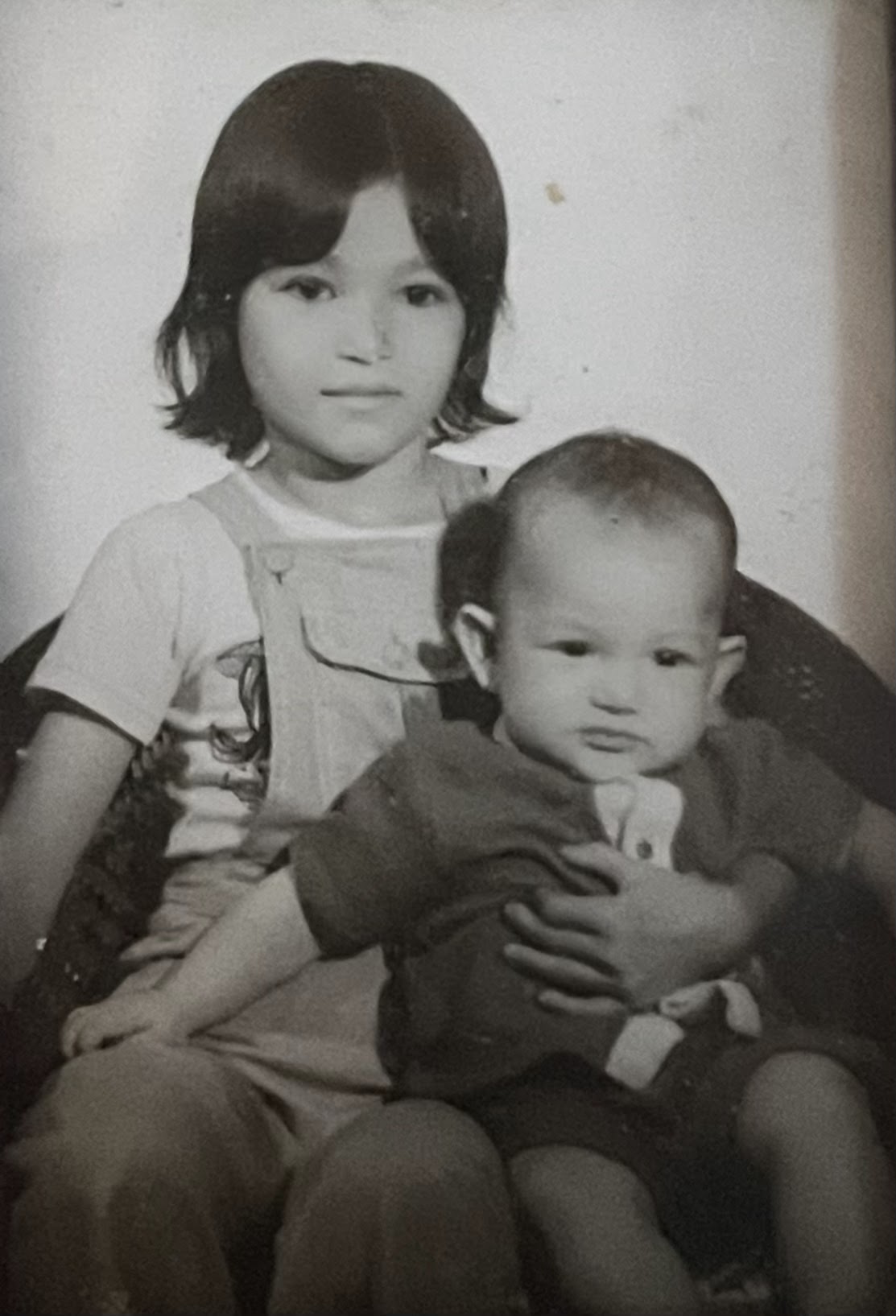
Chinh (8 years old) and her cousin, “Brother Louie” (2 years old).
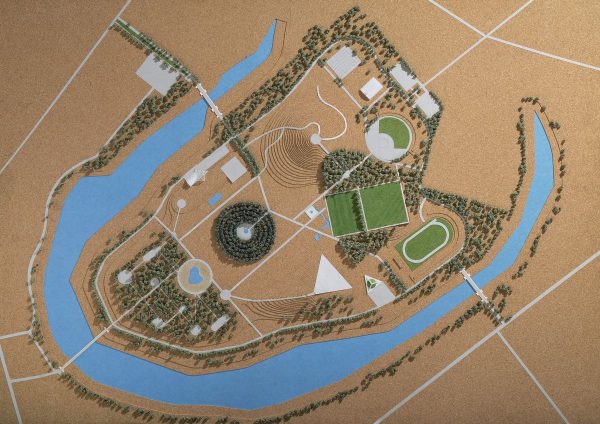
“Kids don’t need instructions to play.” — Isamu Noguchi’s Play Mountain. The imagination a child holds can venture as far out as they desire. Isamu Noguchi sought to stimulate this drive through his art and architecture.
Chinh’s elders did paperwork at Guam and the family soon got transferred to Arkansas for three months. This would be the start of a constantly moving two years in Chinh’s new life in America. After her time there, the government started asking states to sponsor immigrants to help them settle down and find jobs. A church offered to sponsor Chinh’s family in Alabama, so there they flew and stayed at for about a year. Older family members found jobs to get earn some cash (like janitors and fishing), and the children were enlisted in school again. Eventually, they heard that California had better opportunities, so they uprooted their lives and headed for San Diego, California when Chinh was eleven years old. “We slept in cars. It was one moving truck and one big sedan with all fourteen of us stacked on top of each other like sardines. […] We stayed in San Diego for five years and lived pretty remotely. But, once again, my uncles and aunts found greater job opportunities in Orange County, so we packed up our little belongings and moved. There, we finally settled and stayed ever since.”
“My childhood was not a home nor a place. It was just the people around me. We never had the time or a chance to build a childhood.” — Ly Chinh
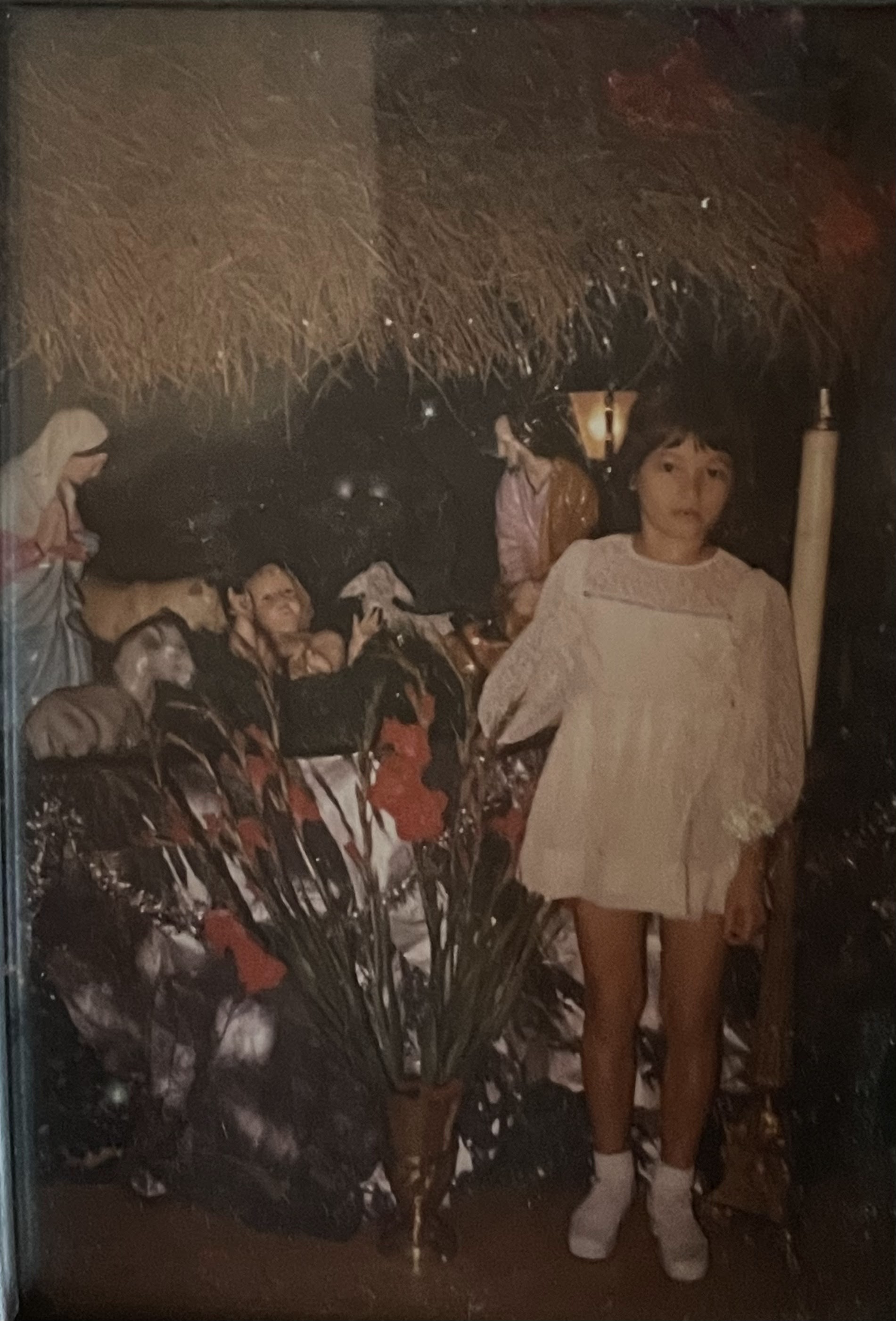
Chinh (10 years old) at the church in Alabama that sponsored her and her family.
Despite not having to deal with extremely abusive treatment or systemic prejudice, Chinh still remembers the harassment her family would encounter on a day-to-day basis. “I didn’t know that I was being bullied until I was fifteen because by then I could fluently speak and understand English. We just accepted the racism. We knew we were different, so we kept our heads low to not be more of a bother to everyone in the community.” This never stopped her from achieving her success. Chinh’s grandparents instilled her with ambitious and driven morals. She knew that America was the “land of opportunity,” so she had to utilize and take advantage of its freedoms to be successful. She reflects, “If I were to still be in Vietnam I would be dead, or have gone nowhere with my life.” Chinh sought education to have a career, and was the first in her family to go to college and get a four-year degree. She became a university counselor and a mother to three children. Chinh’s life was uncontrollably turned upside-down. She would live sacrificing her childhood for her family, and would grow up to build and establish her life in a foreign land where her future was unknown. She is the most admirable person I know.
My father was thirteen years old when he left Vietnam. It was April 24, 1975, six days before the fall of southern Vietnam. Sơn’s brothers and his brother’s girlfriend’s family (making a total of eight) waited on the tarmac of the Tân Sơn Nhất Airport. He could hear all of the bombings just outside the airport as the Communists were closing in. Sơn and his family were one of the “luckier” ones, or as lucky as they could be in a time of war. His father sacrificed his life in the war, making Sơn and his siblings a part of the Orphans of Deceased Veterans program. They were first in line for a way out of Vietnam. On top of this, his oldest brother was already in America working for the government as an engineer for agricultural machinery, and he was acquainted with an American businessman while working. They had multiple connections that secured them a guaranteed flight out.
Sơn’s timeline is less fluctuating than my mother’s, but like most Vietnamese immigrants at the time, he had to pack his things to move quite frequently. Sơn arrived in Subic Bay of the Philippines, but after a few days, he and his family were transported to Guam for a month. On June 24, 1975, they began their stay in Fort Chaffee, Arkansas, waiting for a generous family to sponsor them. Finally, exactly one month later, a generous family in Syracuse, New York, took Sơn and his brother in. Sơn was about to turn fourteen, and had already been traumatized by the separation of his family. However, he is forever indebted to the American people, especially the Wheelless’ who made him one with their family. He reminisces on his first encounter with his new and official American family; “I remember going over the hills. It was late in the evening when we arrived in Syracuse. The sun was setting and over the hill was the family—a completely different life.”
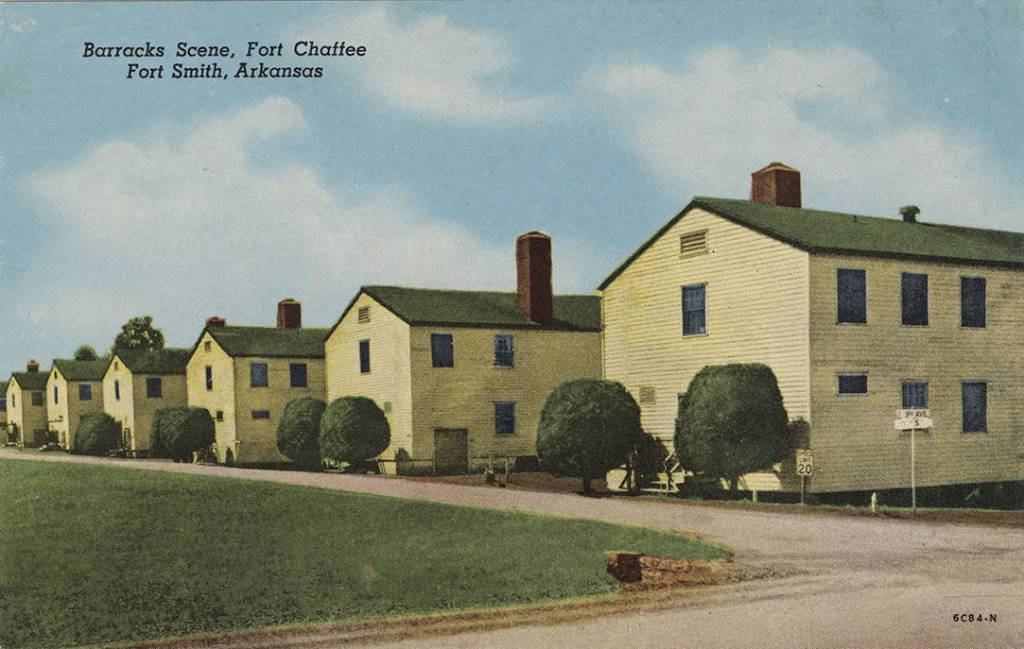
Arkansas military barracks that housed refugees. “Anything was better than Vietnam.” — Thanh Sơn. (Photo Credits: Arkansas Studies Research
With the immense support from his community and second family, Sơn graduated from Westhill High School in 1978, just three years after arriving in the United States, and one year after learning, speaking, and understanding English. When he looks back, he was surprised to realize that there wasn’t really any racism. “Everyone was extremely supportive and welcoming because we were refugees. They may have looked at us funny, but I don’t blame them because they’d never seen an Asian before in their entire lives.”
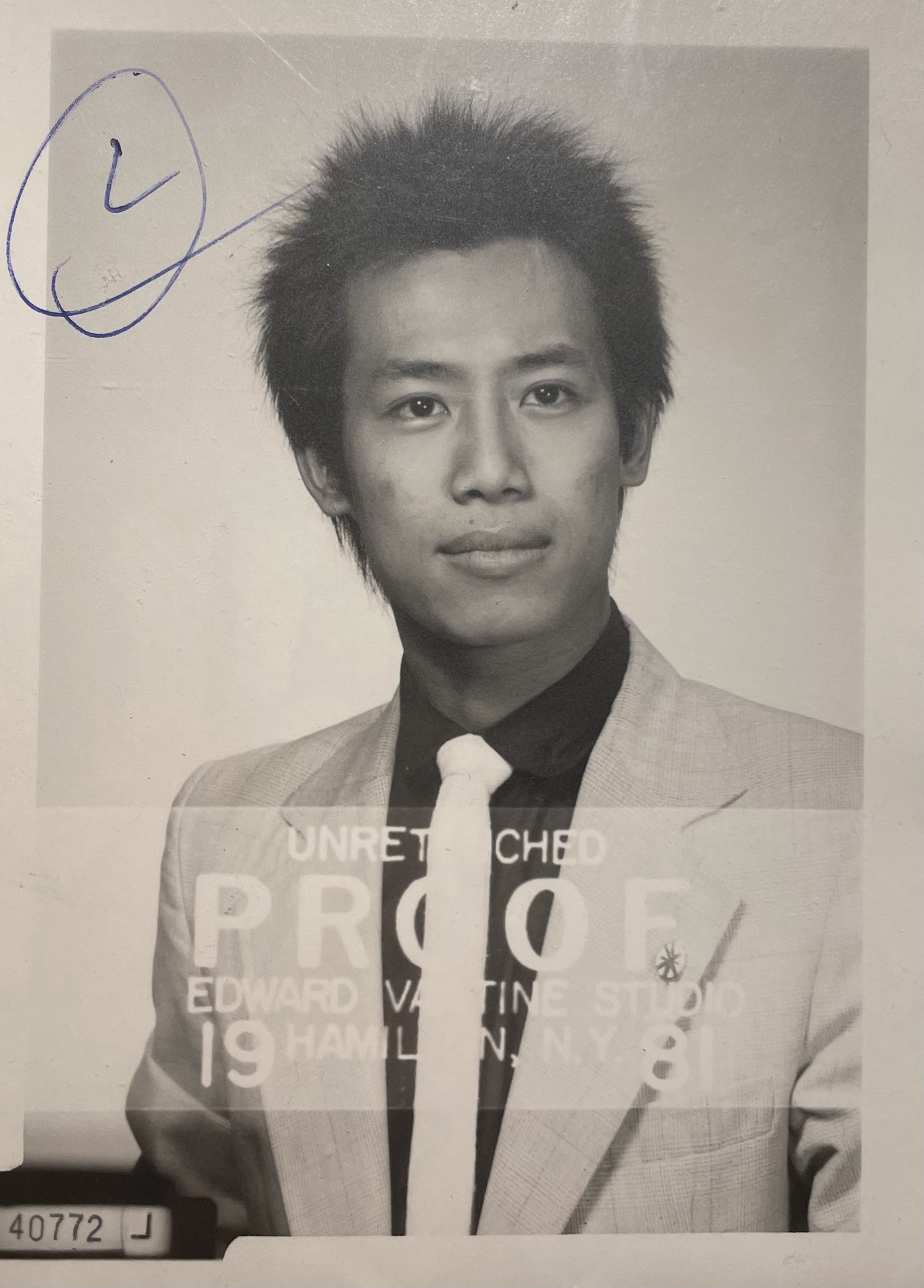
Thanh Sơn
“My American family made me the way I am. […] Some of the Americans were the most generous and beautiful souls. They are very generous people.”
After high school, Sơn was on his own. His blood-related family had gone their separate ways to establish their own lives in America, and Sơn had found himself to do the same. He wanted to be the best. Sơn wanted to fulfill and exceed his potential, prove his worthiness to the little that he was given. A second wave of moving across the country began, but this time for his own purposes and education. From 1978 to 1982, he attended Syracuse University. A year after, he finished his Master’s Degree in Buffalo. After making relentless efforts, he got into medical school from 1986 to 1990. With a week-long, tireless road trip alone to northern California, Sơn went to the University of California, Davis for residency from 1990 to 1995. And lastly, he finished his Fellowship at Stanford University from 1995 to 1997.
From surviving off of one Vietnamese-English dictionary to becoming a prestigious transplant liver and pancreatic surgeon, Sơn built himself up from hardly anything, and unendingly earned every opportunity he was granted. He is the most strong-willed person I know.
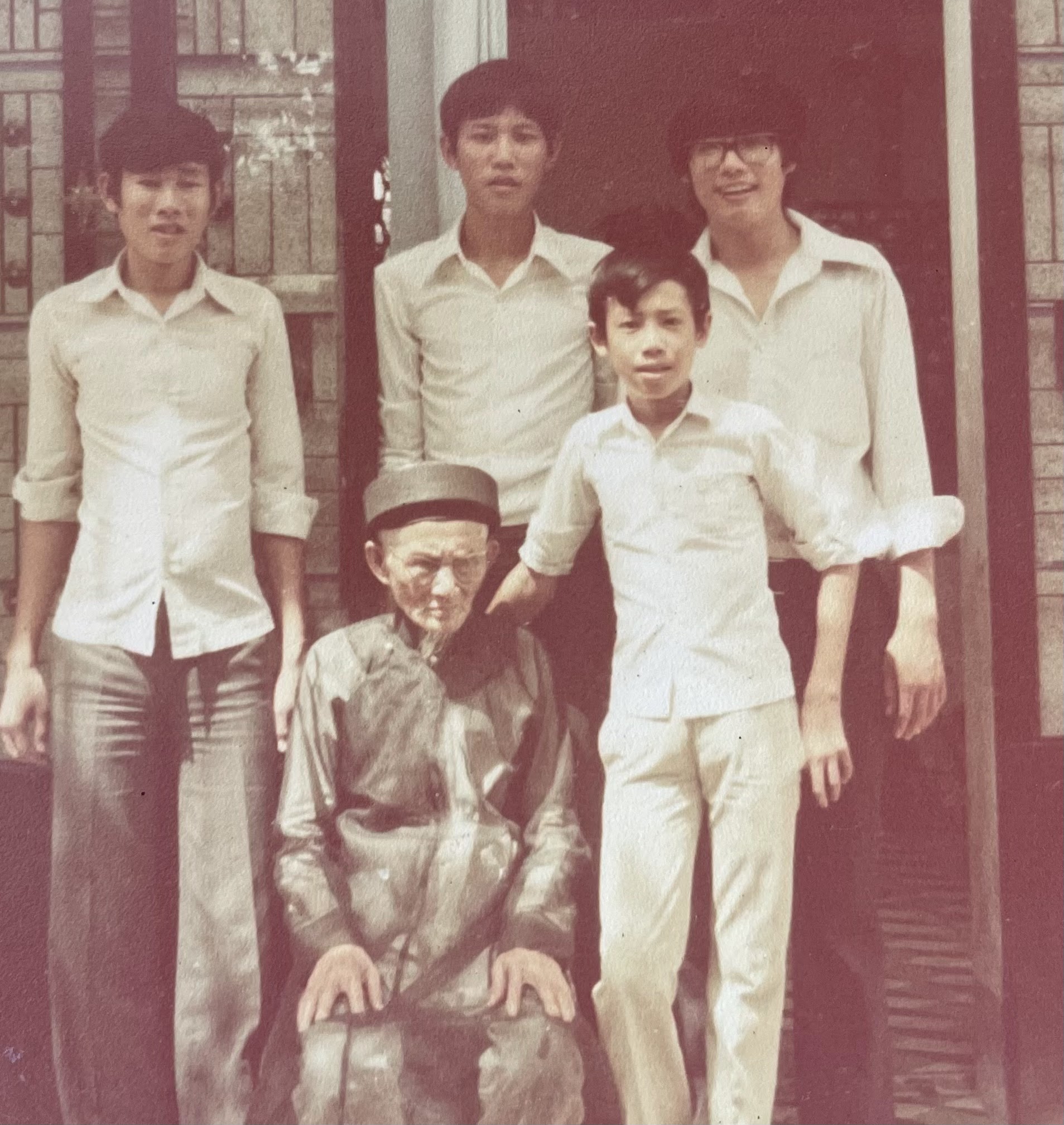
Thanh Sơn (10 years old) and his four older brothers around their grandfather.
“We were forced out of Vietnam because of the war. We were political refugees, not economic refugees. That being said, coming over here granted us more than what Vietnam could have ever done. America is the beacon for everything—for opportunity.”
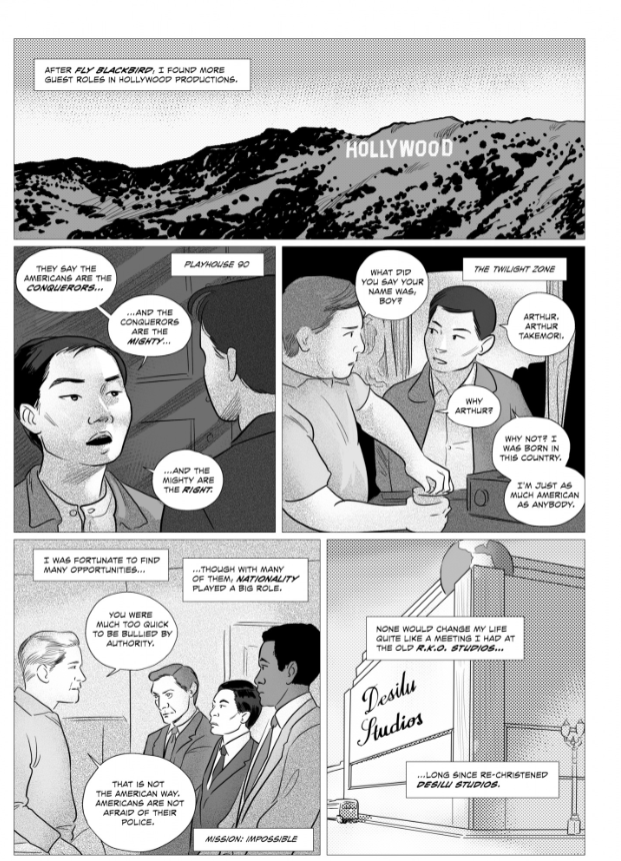
They Called Us Enemy by George Takei
Reading They Called Us Enemy and about the story of George Takei and other Japanese-Americans in the World War II concentration camps inspired me to learn more about my parents and their stories. They, along with most other Vietnamese immigrants going to America, all shared the same situation. They were all categorized into one degrading subject: alienated non-Americans, just as George Takei and the Japanese-Americans were during World War II. Their treacherous stories indulge in the ultimate ending of absolute success born from less than nothing, and I am proud to have such role models in my life to set an example for my future achievements.
They Called Us Enemy by George Takei
Mẹ (mother) and Bố (father) are far from their childhoods of the late 1970s. Though those years do not define them entirely, they still are a part of who and where they are now. Thank you Bố and Mẹ, the strongest people in my life, for continuously working hard for yourselves and for our family. Thank you Thanh Sơn and Ly Chinh for sharing your stories.



 Write Our World
This was a wonderful read.
LikeLike